I Had Rotator Cuff Surgery a Year Ago and It Feels Like It s Torn Again
Frequently Asked Questions
Why am I still having symptoms after rotator gage surgery?
The most common causes of pain afterwards rotator cuff surgery are (ane) that the shoulder is still recovering from the surgery itself and (2) the shoulder has gotten strong due to lack of motility. It is well known that rotator cuff surgery is a major operation where the rotator cuff tendons (Figure one) are sewn back to the upper arm bone (humerus) (Figures 2 and iii).
The other major reason patients have pain subsequently rotator gage surgery is due to stiffness of that shoulder. It is common afterwards rotator cuff surgery to have some stiffness due to the fact that the operation caused the arm to exist held without motion for some fourth dimension. It is important later the surgery to protect the rotator cuff repair for several weeks while it heals, and during this time it is very common for the shoulder to become stiff to a lesser or greater degree. Your doctor and physical therapist tin proceed an eye on this for yous and let you know if your stiffness is the expected amount or too excessive. Often times the stiffness tin can exist treated, and the pain resolves.
It takes the repaired rotator cuff tendons about vi weeks to heal initially to the bone, three months to class a relatively strong zipper to the os, and about six to ix months earlier the tendon is completely healed to the bone. About patients who have had rotator cuff surgery will tell y'all that it takes about nine months before the shoulder feels completely normal. This observation is supported past a study showing that in patients who take had rotator cuff surgery, strength in the shoulder muscles is non fully recovered until nine months after the surgery. Equally a result, it is normal to expect some continued symptoms of pain or soreness later rotator gage surgery for several months.
How do I treat the stiffness?
Y'all should always follow the directions of your surgeon after surgery, since some tears need more time to heal than other tears. The best thing is to listen to your doc likewise every bit the concrete therapist involved in your care. We tell our patients that water ice is helpful for the pain, along with hurting medicine of some sort, such as acetaminophen (e.g. Tylenol), anti-inflammatory medications (east.g. aspirin, ibuprofen, naproxen, etc.), pain relievers (not-narcotic or narcotic) and even prednisone by oral fissure (east.thou. cortisone dose packs). You lot should take these medications only at the direction of your doctor. Nosotros usually recommend that during the get-go iii months the emphasis in physical therapy and with your home plan should be on regaining motility in your fingers, wrist, elbow and shoulder. Nosotros tell patients they accept the remainder of their lives to get strong, but during the first four months after rotator cuff surgery, the major goal should be largely to regain motility in the shoulder. Stiffness in the shoulder can exist the crusade of pain months later on the surgical repair, so it is important that stiffness be addressed fifty-fifty months or years after the surgery.
How much therapy should I have after surgery?
Your surgeon can answer this since they are the ones who know how much work had to exist done to repair the tendons. The doctors can prescribe therapy based on the work washed during the operation. If more than ane tendon had to be repaired or if the tendon tear is a big tear, the surgeon may recommend that the therapy progress slower to permit more time for healing; on the other hand, if the tear is small, they may let a lilliputian more motility before than usual after the surgery.
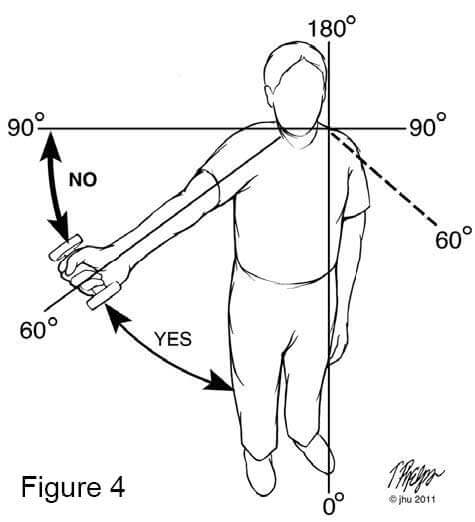
It is possible to have too much therapy, and that is usually experienced every bit lots of pain later on the therapy session or pain for days subsequently the therapy session. It is important that the physical therapist has a dialogue with you lot to make sure that the exercises are washed at a proper stride for your particular surgery. We typically recommend concrete therapy only twice a calendar week. However, nosotros recommend that patients stretch on their own the other days when they practise not see the therapist. Sometimes physical therapy with the therapist iii times a week is indicated, and this should be discussed with your physician and physical therapist. Similarly, it is typically not necessary to stretch more than once or at well-nigh twice a day with a home program. Lastly, if strengthening exercises are causing you hurting, we recommend that you exercise non do the exercises over threescore degrees of elevation of the shoulder (Effigy 4). This is considering the rotator cuff begins to take increased stress above this level, and information technology tin worsen the pain if the shoulder is irritated already. We recommend that you water ice the shoulder after any exercise program to keep the pain under control.
What if I experience a tear or pull in therapy?
Information technology is non uncommon to have a modest "twinge" or "pull" in concrete therapy, which typically does non mean that the rotator cuff repair has failed. Normally these pocket-size twinges are usually goose egg to worry well-nigh. It is not really known what causes them, only it is believed that it may exist scar tissue being stretched or the shoulder joint moving around unremarkably in the socket. It would be rare for the therapy to actually cause a repaired tendon to tear, as volition exist discussed later.
How do I know if the tendon repair has torn once more?
It is not easy to tell if the rotator cuff tendon repair has failed or not. The symptoms of pain or loss of strength are common after rotator gage surgery while the tendons are healing, and minor setback are to be expected. Nosotros practice not recommend a magnetic resonance scan or other studies when these setbacks occur for several reasons. The outset reason is that magnetic resonance imaging later on a surgical repair of the rotator gage does not have the aforementioned accurateness in determining whether tendons are torn. If an MRI is performed, we recommend that it be performed with dye in the affected shoulder (arthrogram) with a needle under x-ray or CAT scan guidance by a radiologist. This test is called an arthrogram-MRI and may be positive if the tendon has not had enough fourth dimension to heal or if parts of the tendon accept not healed to os. Every bit a result, within three months later a rotator gage repair, information technology is common for the dye to leak through the tendon since it has not completely healed. After this flow of time, the degree of tear in the tendons tin be adamant all-time with this report.
What do I practice if my tendon has not healed?
The reality of rotator cuff surgery is that while virtually tendons heal back to the bone later surgery, not all repaired tendons heal completely, and some do not heal at all. At that place are many reasons for this lack of healing with surgery. The first is that the rotator cuff tendons are large tendons which may have also extensive damage to heal. The rotator cuff tendons are big, and there are four of them. Each rotator cuff tendon is as thick every bit your pinkie and as wide every bit two to three fingers. The adventure that the tendons will heal with surgery is directly related to how large the tear in the tendons was before surgery. How to decide the size of the rotator gage tendon tear volition be discussed beneath.
The second reason that the tendons may not have healed with surgery is that these tendons brainstorm to wear out in most humans showtime around the age of 30, and the amount of wear and tear varies from person to person for reasons we do not sympathize. This wear of the tendons occurs in some people but not in others. By the age of 50, many people have some wear of their rotator cuff tendons.
When rotator gage tendons tear prior to whatever surgery, there are 2 ways they tin tear. The starting time is that there is an injury that pulls the tendon off the bone. When this happens, in that location is still some tendon left to repair with very little tendon missing. However, in many cases when the tendon tears with minimal trauma, the reason the tendon tore in the first place was because it already had some vehement due to vesture and tear over the years. This habiliment and tear over time is the second way the tendon can tear. This type of tear is best described as a tear that occurs in a style analogous to "wearing a hole in the seat of one'southward pants"; the tendon just gets thinner and thinner over time until in that location is a hole there (called an "attritional tear"). This type of rotator gage tendon tear typically happens without the person being enlightened that it is happening.
The affair that is strange about this type of rotator gage tear is that they can occur and not cause any problems until the tear gets large. These "wear a hole in your pants" tears tin exist any size from the size of a pinhole to "massive" tears where in that location is little tendon left. In these tears, the edge of the tendon at the pigsty is thin, and it is difficult to sew information technology back together. If one tries to repair a pigsty in the tendon that is the size of one fingernail or smaller, it is easier to repair than a larger hole. In large holes caused by this type of damage (attritional or "wear a hole in your pants" type of tear), the rotator cuff tissue around the edges is non every bit sturdy, and 1 is request the tissue to fill up a pigsty where there is actually no tendon. For this reason, the major factor in determining whether a rotator gage tear tin can heal is how large the hole was to being with prior to the surgery. The larger the rotator cuff tear before surgery and then the higher the failure rate of surgery.
How do you lot depict the size of tendon tears?
The first way to describe tears of the rotator gage tendons is whether tears are part of the way through (chosen "partial thickness") or all the way through the tendon (chosen "total thickness". The tears of the rotator cuff tendons tin be partial thickness (like sawing through a rope part of the way) (Figure v) or they can progress to tears all the fashion through the tendon (like sawing all the way through a rope) (Figure 2). In one case a tear is all the manner through the tendon (chosen "full thickness"), the side by side issue to consider is the size of the hole in the tendon. Equally the tendons tear more, they can be of any size (depth and width).
The normal beefcake of the shoulder and rotator cuff tendons are demonstrated in Figure half dozen. Full thickness tears of the rotator cuff are described equally small-scale, medium, large or massive (Figures 7, 8, nine and 10). Since about rotator cuff tendons are about equally wide as iii of your fingers, a small tear would be i the size of your fingernail or smaller (less than i centimeter of tendon torn) (Effigy vii). A moderate size full thickness tear through the tendon would be one that is the size of 3 fingernails (most one centimeter in one direction and three centimeters in another). Usually tears of this size hateful the whole tendon width is pulled off of the bone (Figure viii). A large tear is one that would mean the tendon is torn from the knuckle to your fingertip; this is called a large or massive tear (Figures 9 and 10). It is also possible to tear more than one tendon completely. The size of the tear is very important as it determines the chances that the tendon will heal with surgery.
What are the chances a tear will heal with surgery?
There accept been many studies that tell us approximate odds of tendons healing with surgery depend upon the size of the tendon [1, 3, vii, thirteen]. It has been demonstrated that pocket-size full thickness tears the size of a fingernail (one centimeter) (Effigy 7) heal in a majority of cases, but approximately five% will not heal for the reasons mentioned in the give-and-take in a higher place. For full thickness tears that are moderate size (one to three centimeters), the re-tear rate is around 20% (Figure 8). For large tears (three past five centimeters), the re-tear rate is approximately 27% (Figure 9). For massive tears (where one tendon is largely or completely gone or more than one tendon is torn), the re-tear rate is anywhere from 50 to 90% [8, xiv] (Figure x). The reason for this high failure charge per unit with large to massive tears is because there is a hole as well big to be filled past stretching the remaining tendon, and the edges of the tendon will not hold the stitches used in the repair of the tendons.
So what do I do if a rotator cuff tear fails?
Commonly a tendon repair fails considering it was going to fail and not because of a bad surgery or bad therapy. The reality is that rotator cuff surgery is non perfect, and not all tendons will heal completely with surgery. Once a tendon has failed an attempted surgical repair, the odds are that information technology will be hard to repair again and to become it to heal. In some cases, the tear may be small enough later on a failed repair to be successfully repaired, but the exact chance of failure with further surgery is related to how large the tear is at that time. The larger the tear, the less probable it can be successfully repaired a 2nd time. In most cases a 2nd attempt at repairing the tendon is non going to be successful unless the tear is small.
If the tendon has re-torn and cannot be repaired with further surgery, there is all the same promise for the function of the shoulder; the shoulder is not doomed and all is non lost. There are two myths about rotator cuff tears. One myth nearly rotator cuff tears is that the shoulder is doomed if the tendon is not repaired. The reality is that some people can have proficient range of motion and role with torn rotator cuff tendons. The caste of symptoms after a failed rotator cuff repair depends upon many factors. The typical symptoms of shoulders with un-repaired tendon tears are weakness with lifting above shoulder level or away from the torso. The symptoms can often exist controlled past watching one's activities, maintaining a expert range of movement of the shoulder, and beingness careful near how much lifting i does with the shoulder. Basically one can do whatever activeness he/she chooses as long as it does not injure. Nosotros recommend that the patient lets their symptoms be their guide to activeness level.
The second myth virtually have a rotator cuff tear that is too big to repair is that the shoulder is doomed to go arthritis or to gradually lose office. There is no manner to predict what rate the shoulder will accept any problems or if it volition have any problems at all. At that place is just one study which has suggested that the shoulder with no rotator cuff tendons may develop arthritis over time [10]. This study was not conclusive, so it is currently believed that being active does not pb to degeneration of the shoulder when there are irreparable tears. We encourage people with torn rotator gage tendons that cannot be repaired to be equally active equally possible inside the limits of their pain and weakness.
What almost patching upwards the pigsty?
For decades there have been many attempts at finding some tissue or something manufactured to put in the hole of the torn rotator cuff tendon to help it heal. Unfortunately most of those attempts take failed as they do not regenerate or heal the pigsty in the rotator cuff tendons. Things that accept been used unsuccessfully to patch the hole in the past include a person'south ain tissue (called "autografts" and include iliotibial band and biceps tendon), a cadaver or human being donor tissue (called "allografts" and include iliotibial ring and posterior tibialis tendons from the leg), tissue from animals (called "xenografts" and include sterilized squealer-gut mucosa) and more recently patches fabricated from culture cells (human peel cells, fibroblast scaffolds). In most instances these have no restored role and strength to the shoulder, and they should be considered experimental at this time. Nosotros exercise not recommend them in most instances, especially in tendon tears that take had previous surgery that has failed. Some physicians recommend these patches in tears that are very big, but the failure charge per unit is exceedingly high. In that location is currently no known or proven advantage to using patches in the repair of torn rotator cuff tendons.
What nigh tendon transfers?
A tendon transfer is an operation where the tendon of another muscle around the shoulder is moved to replace the rotator gage tendon. There are a couple of tendon transfers that take been described for this purpose [2, 9, xi]. The first is a big musculus in the back of the shoulder called the "latissimus dorsi musculus." While this is a large muscle, the tendon is really very sparse and non very large. While this performance was one time advocated for patients with large rotator cuff tears with pain, the results were not every bit good equally initially reported. This performance is helpful for just a minority of patients and has lost favor amid shoulder surgeons [12].
A second musculus and tendon transfer that was described in one case was the use of the deltoid muscle and tendon every bit a buffer or spacer for the infinite where the rotator cuff tendons were located. This functioning was largely a failure and is no longer recommended.
What about shoulder replacement?
Shoulder replacements for patients with rotator cuff tears tin can be successful but patient eligibility continues to modify and evolve. Typically shoulder replacements are reserved for patients with torn rotator cuffs who also have arthritis of the shoulder articulation. The replacements are non often used for patients who have but loss of motion alone, and we tell patients that the replacements are indicated mainly for reducing pain in the shoulder. Nevertheless, equally at that place are increasing improvements in shoulder replacements, this may change and should be discussed with your doctor.
There are several kinds of shoulder replacements bachelor for patients with arthritis and painful rotator cuff tears. Each type has its advantages and disadvantages depending on the age of the patient, the activeness level of the person, and the amount of damage to the shoulder. In some instances it might be best to supplant the shoulder with a more conventional shoulder replacement. A relatively new prosthesis called the reverse prosthesis has had some promise in patients with arthritis and torn rotator cuff tendons that are not repairable. These operations are generally very good for pain relief and practice consequence in some improvements of motion. The pluses and minuses of these procedures should exist discussed with your medico.
References
- DeOrio, J.K. and R.H. Cofield, Results of a 2d try at surgical repair of a failed initial rotator-cuff repair. J Bone Joint Surg Am, 1984. 66(4): p. 563-7.
- Chaffai, M.A. and M. Mansat, Anatomic basis for the construction of a musculotendinous flap derived from the pectoralis major muscle. Surg Radiol Anat, 1988. 10(iv): p. 273-82.
- Harryman, D.T., 2nd, et al., Repairs of the rotator cuff. Correlation of functional results with integrity of the cuff. J Os Joint Surg Am, 1991. 73(7): p. 982-nine.
- Rokito, A.Southward., et al., Forcefulness after surgical repair or the rotator cuff. J Shoulder Elbow Surg, 1996. v(i): p. 12-7.
- Rokito, A.Due south., et al., Long-term functional outcome of repair of large and massive chronic tears of the rotator cuff. J Bone Joint Surg Am, 1999. 81(seven): p. 991-7.
- Davidson, P.A. and D.W. Rivenburgh, Rotator gage repair tensions as a determinant of functional outcome. Periodical of Shoulder and Elbow Surgery, 2000. 9(6): p. 502-506.
- Jost, B., et al., Clinical result afterwards structural failure of rotator cuff repairs. J Os Joint Surg Am, 2000. 82(three): p. 304-14.
- Motamedi, A.R., et al., Accurateness of magnetic resonance imaging in determining the presence and size of recurrent rotator cuff tears. J Shoulder Elbow Surg, 2002. xi(1): p. 6-ten.
- Iannotti, J.P., et al., Latissimus dorsi tendon transfers for irreparable posterosuperior rotator cuff tears. Factors affecting outcome. J Bone Joint Surg Am, 2006. 88(two): p. 342-viii.
- Zingg, P.O., et al., Clinical and structural outcomes of nonoperative direction of massive rotator cuff tears. J Bone Joint Surg Am, 2007. 89(ix): p. 1928-34
- Derwin, K.A., et al., Rotator cuff repair augmentation in a canine model with use of a woven poly-L-lactide device. J Os Joint Surg Am, 2009. 91(v): p. 1159-71.
- Nove-Josserand, L., et al., Results of latissimus dorsi tendon transfer for irreparable cuff tears. Orthop Traumatol Surg Res, 2009. 95(2): p. 108-13.
- Slabaugh, M.A., et al., Does the literature confirm superior clinical results in radiographically healed rotator cuffs subsequently rotator cuff repair? Arthroscopy, 2010. 26(3): p. 393-403.
- Kluger, R., et al., Long-term Survivorship of Rotator Cuff Repairs Using Ultrasound and Magnetic Resonance Imaging Assay. Am J Sports Med, 2011.
easterlingcipen1988.blogspot.com
Source: https://www.hopkinsmedicine.org/orthopaedic-surgery/specialty-areas/shoulder/treatments-procedures/failed-rotator-cuff-repairs.html

Post a Comment for "I Had Rotator Cuff Surgery a Year Ago and It Feels Like It s Torn Again"