Andrew Jackson's Face on a Baby Dead Party
VOA Learning English language presents America's Presidents.
Andrew Jackson, the seventh president, was unlike the earlier U.S. presidents.
His family was poor, he had little education, and he lived on what was then the western part of the country.

Jackson became nationally known in the early 1800s – outset equally a fighter against Native American tribes, and then every bit a general in the War of 1812 against the British.
His image every bit a military machine hero and man of the people fabricated him a pop choice for the presidency.
But critics said Jackson did not take whatsoever limits on his power.
He is also remembered for supporting slavery, and for forcing Native Americans from their homes.
Wild child
Andrew Jackson's parents were immigrants from Ireland. His father died in an accident before Andrew, the third and youngest son, was born.
When the American colonies entered a war of independence, Andrew and his 2 brothers fought against the British – although Andrew was also immature to be a regular soldier.
Andrew'southward oldest brother before long died.
And so Andrew and his other blood brother were both captured by British soldiers. One cut Andrew's face up, leaving a scar that remained his entire life.
But Andrew, unlike his brother, survived captivity.
A curt time later, Andrew'due south female parent became sick and died.
By age 15, Andrew Jackson had no living immediate family.
He had already stopped attending school, merely taught himself enough to go a lawyer. He moved to what became Nashville, Tennessee, where he adult a successful law career.
In fourth dimension, he bought land and slaves.
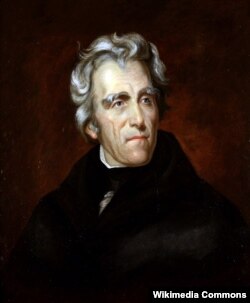
Jackson was tall and thin, with red hair and vivid blue optics. Sometimes Jackson was playful. He loved to dance, hold parties, and play games where he could win money.
Sometimes he was violent. He was known for getting angry easily. Jackson fought duels with several men. In ane, he killed a man who insulted his wife.
Yet many people liked Jackson'southward passionate, action-offset personality. By the fourth dimension the United States entered the War of 1812, Jackson had been a congressman, senator, and gauge.
Three nicknames
Jackson did not have any officially recognized war machine training. Merely during the State of war of 1812, he volunteered in the Tennessee militia and rapidly took control of troops.
Many of his soldiers came to respect him. Jackson refused to give up, even when the authorities ordered the militia to disband. And, when some of the men wanted to leave, he threatened them with a gun.
Because he was uncompromising and strong as a tree, soldiers chosen Jackson "Erstwhile Hickory."
A grouping of Creek Indians gave him another name. Later he defeated them in battle, Jackson negotiated a treaty that punished both his Native American enemies and his Native American allies.
The treaty was more severe than the U.South. government had asked. In time, it forced the Creeks – as well equally several other tribes – off their land.
The move was popular with many white settlers. It was less popular with the Creeks, who called Jackson "Precipitous Knife."
His all-time-known armed services operation was in New Orleans, Louisiana. A large, experienced army of British soldiers moved to attack. Jackson dedicated the city with a small group of untrained soldiers. His group included volunteers, complimentary blacks, Creoles, Native Americans, and pirates.
Jackson'due south ragtag troops not merely defeated the British force, but suffered only a few losses.
Jackson didn't know that the boxing came after the British and Americans had already agreed to end the war. Only his victory in that location gave many Americans a feeling of pride.
Information technology likewise made Jackson famous. He became known across the country every bit the "Hero of New Orleans."

A human of the people
Voters across the country supported Jackson, too. He was specially well-liked in the South and West.
Many Americans saw him as a man of the people. They believed his success came from feel and difficult piece of work, not wealth and family connections.
In the presidential election of 1824, Jackson received more than popular and electoral votes than whatsoever of the other candidates. Merely, because no candidate had a majority, lawmakers in the House of Representatives decided the election.
Those lawmakers chose John Quincy Adams, the son of quondam president John Adams. They were persuaded, in part, because a leader in Congress, named Henry Clay, said Jackson did not take the temperament to exist president.
Immediately after Quincy Adams won, he appointed Clay secretary of state.
The date angered Jackson. He believed Adams and Clay had entered into a "corrupt bargain."
In the next presidential election four years afterwards, Jackson defeated Quincy Adams in a landslide.
And in the presidential election after that, he crushed Henry Clay.
A powerful president
Jackson wanted to be a powerful leader who controlled a express federal government. But he wanted that government to take power over land governments.
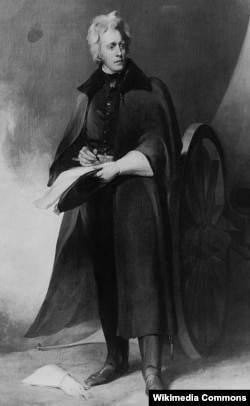
For example, Jackson refused to let the state of South Carolina nullify, or ignore, a federal law that state officials opposed. Jackson said if they failed to obey the constabulary, he would consider them traitors and send in troops.
In time, S Carolina and Congress were able to accomplish a compromise on the law.
Jackson as well refused to extend the charter of the National Bank. He believed the bank helped industrialists and businesses more than than farmers and settlers. His move was popular with many voters – especially farmers and settlers.
But Jackson's opponents warned against the bank veto. They disagreed with his economic plan, and they objected to how he had operated outside of Congress. Senators censured Jackson for acting equally if he did not have to follow the law.
Jackson's supporters fought back. They removed the official criticism from the Senate records.
Indian Removal Human activity of 1830
Jackson vetoed more bills than the start six presidents combined. He actively worked for just one major police: the Indian Removal Human action of 1830.
Jackson believed Native Americans occupied land that should belong to white settlers. He also thought Native Americans would be destroyed or lose their civilization to white people anyway.
And so he offered several tribes what appeared to be generous treaties to motion onto country westward of the Mississippi River.
But the treaties were often unfair or illegal. The tribes who accepted rarely received the benefits Jackson promised them. And some tribes, such equally the Cherokees, just refused to go.
Empowered past Jackson's Indian Removal Act, U.S. regime officials eventually forced xv,000 Cherokees off their land. They were made to march over one,600 kilometers. Nigh iv,000 died on the march. Information technology is remembered as the "Trail of Tears."
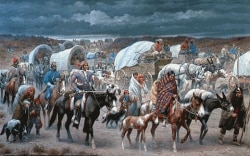
For white settlers, Jackson's Indian removal policies resulted in over 100,000 square kilometers of new land to farm. Thousands of cotton planters moved west with their enslaved workers.
The Indian Removal Act served not only to assistance an economical boom in cotton fiber, but to spread slavery further in the United States. Jackson had no objections.
Final years
In 1837, Jackson officially moved out of the White House – but he did not really leave the presidency. He brash the presidents who followed him from his home in Tennessee.
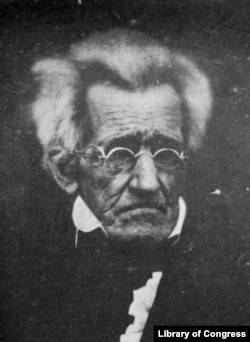
Jackson had particular influence over two future leaders: Martin Van Buren, his former vice president; and James Polk, who shared Jackson's behavior and then closely that he was called "Young Hickory."
Jackson's love wife, Rachel, had died before he took office. They did not have any children together, but they raised two boys: a Native American orphan who died as a teenager; and a nephew, whom they called Andrew Jackson, Jr.
The younger Andrew Jackson and his wife lived with the former president in his final years.
He died in his bed at 78 of sometime wounds and old age. But his legacy remains very much alive.
Legacy
Jackson changed the U.Southward. presidency. After him, presidential candidates had to testify they could connect with voters, not just lawmakers.
He also increased the power of the chief executive. Jackson oft questioned – or dismissed – the power of Congress, the Constitution, and the Supreme Court.
And, he began the custom of replacing experienced government officials with people whose main qualification was their loyalty to him.

Critics added to Jackson's nicknames. They called him King Andrew, King Mob, or American Cesar. The opposition to Jackson led to a new political party called the Whigs.
Part of Jackson's legacy is the ii major party arrangement that exists in the U.S. today.
Merely those who loved Jackson really loved him. His humble beginnings, rise to power, and defense of the common man inspired them.
In the U.S., the name of Andrew Jackson is still often used every bit a positive symbol of American republic.
I'm Kelly Jean Kelly.
_________________________________________________________________
Words in This Story
homo of the people - north. a political leader who understands and is liked past ordinary people
pride - n. a feeling that yous respect yourself and deserve to exist respected by other people
temperament - n. the usual mental attitude, mood, or beliefs of a person
nullify - 5. to make something legally null
charter - north. a document issued by a regime that gives rights to a person or group
generous - adj. providing more than the amount that is needed or normal : arable or aplenty
legacy - n. something that comes from someone in the past
main executive - northward. the president of a country
qualification - n. a special skill or type of experience or knowledge that makes someone suitable to do a detail job or activity
Come across how well you understand the story and develop your listening skills by taking this listening quiz.
Quiz - America'southward Presidents: Andrew Jackson
Start the Quiz to detect out
easterlingcipen1988.blogspot.com
Source: https://learningenglish.voanews.com/a/americas-presidents-andrew-jackson/3787327.html

Post a Comment for "Andrew Jackson's Face on a Baby Dead Party"